
Why Stuttering Belongs at the Neurodiversity Table: Insights from Our Expert Panel
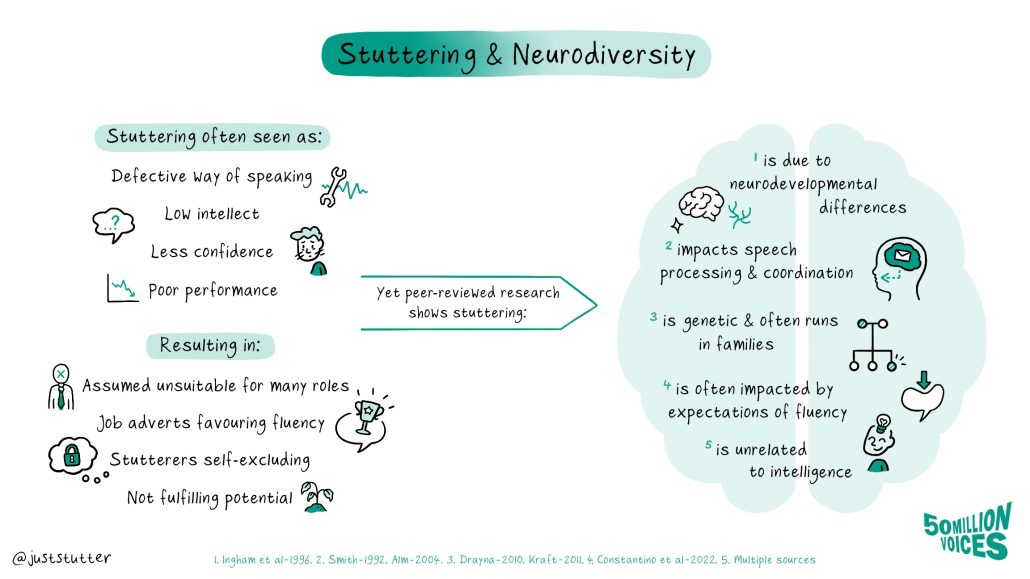
For too long, society has misunderstood stuttering. It has been mischaracterised as a sign of nervousness, shyness, or a lack of confidence. However, the science and the lived experiences of fifty million working people worldwide tell a different story.
To mark Neurodiversity Celebration Week, 50 Million Voices hosted a special virtual panel as part of our 10th Global Practice Interview Event. Chaired by our Founder, Iain Wilkie, we brought together an international panel to explore a vital yet often overlooked fact: that stuttering is a neurodivergent condition.
By bringing stuttering to the neurodiversity table, we can change the workplace narrative, moving away from outdated stigmas and toward a deeper understanding of the unique strengths people who stutter bring to their teams and their employers.
Here are the key takeaways from our panel chat about the intersection of stuttering, neurodivergence, and the world of work. Some quotes have been lightly edited for clarity.
Stuttering as Neurodivergent Speech
The foundation of our discussion centred on challenging the status quo and raising awareness of the fact that stuttering is the result of different neurological wiring - a natural variation in how the brain processes speech.
"People who stutter have typically been seen as being shy, nervous, lacking confidence, or highly introverted. What the neurodivergence science suggests is that none of those things are true... ultimately, our stuttered speech is simply neurodivergent speech." - Iain Wilkie, Founder of 50 Million Voices and former EY Partner
Recognising stuttering as neurodivergent speech is the first step for employers to start viewing it not as a barrier, but through a lens of strength in difference.
Intersectionality: Autism, OCD, and Stuttering
Many people who stutter also navigate other neurodivergent conditions. Our panellists shared personal insights into how these experiences overlap and shape who they are at work and in life.
Alex Harrison, an IT Major Incident Manager in the UK Civil Service, talked about navigating the workplace as an autistic person who stutters. He highlighted the challenges of masking, noting that while autism can sometimes be hidden, a stutter is highly visible and audible. But he also spoke about living with both:
"I see both [autism and stuttering] as equal parts of who I am as a person and who I am as an employee... I see it more as the ebb and flow of my experience of speaking and my experience of living. It’s like that natural up and down, which is fairly common in both stuttering and autism." - Alex Harrison, PWS and Autistic Professional
Willemijn Bolks, a freelance artist from the Netherlands, drew parallels between her experience with stuttering and her recovery from OCD. She noted how the pursuit of "control" often makes things harder in both conditions:
"Often the stuttering is seen as the problem, even though actually the controlling of it is what creates the struggle. And I've also experienced that with OCD... In both of them, it has been really helpful to embrace the lack of control and embrace uncomfortable feelings." - Willemijn Bolks, a PWS and Artist recovering from OCD
Willemijn also highlighted the benefits of the community that comes from these shared experiences, adding: "I have experienced so much richness in friendships... it has really added to my life to be in these communities and share about these experiences."
---
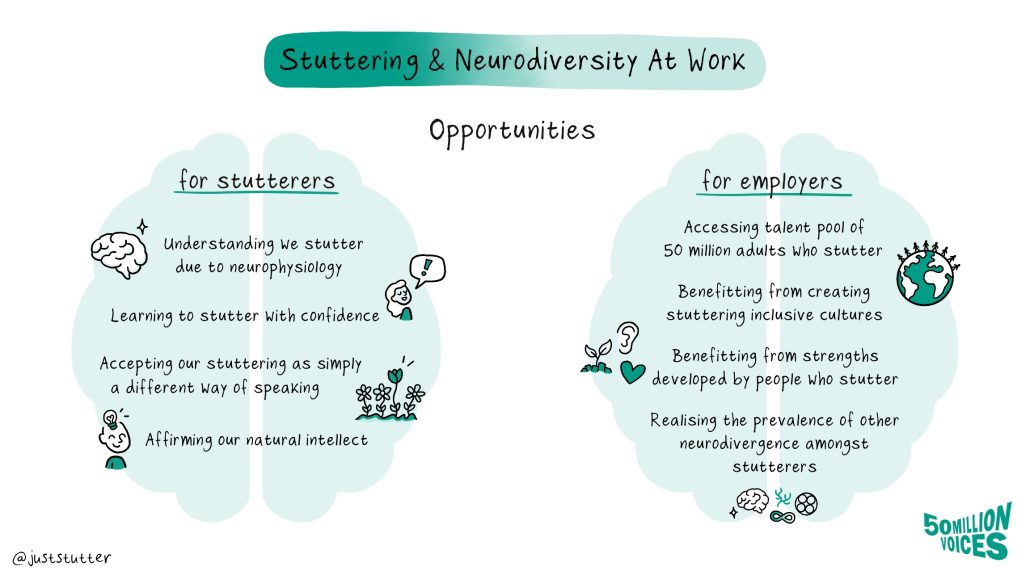
50 Million Voices created the infographic below on Stuttering and Neurodiversity at Work, and commissioned Willemijn (JustStutter) to draw the artwork:
What This Means for Employers and Allies
For Diversity, Equity, and Inclusion (DEI) strategies to be truly inclusive, they have to make room for stuttering and other speech differences.
Anita McKiernan, a Highly Specialist Speech and Language Therapist who works with City Lit and City St George’s at the University of London, emphasised that employers will see rewards if they take the time to understand the individual:
"Having a stutter is not a one-size-fits-all... I think employers should be very open and not make assumptions… to take time to get to know the employee and to open up conversations, acknowledging the strengths that the person can bring to the table by way of potentially unique ways of seeing things, ability to process, think differently, or see things outside the box." - Anita McKiernan, Specialist Speech & Language Therapist and Ally
Iain summed up the employer takeaway very well, saying: "The time invested in somebody to understand how they are different, and not pigeonhole them into one category, earning their confidence… pays back many times over."
Keeping the Conversation Going
In addition to our expert panel, we wanted to hear from our attendees, too. Halfway through the event, our participants headed into breakout rooms for a 15-minute interactive discussion.
Small groups of three shared their lived experiences, discussing what they found interesting about the panel and how vital it is for stuttering to be recognised as a neurodivergent condition at work.
We then came back together for a concluding group chat. The energy in the virtual room was positive, vulnerable, and inspiring. It was a perfect reminder that when we create spaces for authentic connection, real workplace transformation can begin.
Stuttering deserves a permanent seat at the neurodiversity table. By embracing uncomfortable feelings, letting go of fluency bias, and fostering authentic connections, we can build a world of work where all voices are valued exactly as they are.